- ALL
- TRENDING
- PERFORMANCE
- CHARGING
- BATTERY
- DESIGN
- TECH
- NEWS
Why Range Anxiety is More Psychological Than Technical for Electric Bikes?
 Oben Electric
 Wed Apr 08 2026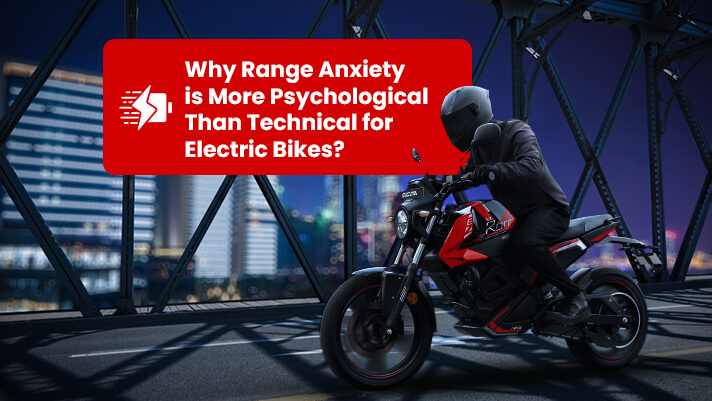
Table of Contents
Why Most Riders Overestimate Their Daily Travel Needs?
The Psychological Side of Electric Bike Range Anxiety
The Technical Reality of Modern Electric Bikes
Real World Range vs Claimed Range
Battery Indicators and Smart Systems Reduce Risk
How Riders Can Overcome Electric Bike Range Anxiety?
The Future: Range Anxiety Will Reduce as EV Adoption Grows
It is a regular Monday morning. The electric bike is fully charged, and the commute starts. But somewhere between the home and the office, one thought occurs, "Will the battery last?" The mind tends to jump to the worst-case scenario of electric bike range, which almost never happens in the reality of daily riding.
This is range anxiety, one of the most misunderstood and talked-about concerns in the 2 wheeler electric bike space. It is the fear of running out of battery before reaching the destination, with no way to charge up quickly. It is also one of the most common reasons people hesitate before buying an electric bike.
Range anxiety is not really a battery problem. It is a perception problem, rooted in unfamiliarity with the electric bike range. Let’s break down why the range anxiety fear lives more in the mind than on the road.
Why Most Riders Overestimate Their Daily Travel Needs?
In India, most electric bike riders suffer from electric bike range anxiety and overestimate how much they actually have to travel in a day. It is often built on imagined distances rather than real ones.
Think of a typical day. Office commute, a quick stop at the grocery store, maybe a school pickup, or dropping by at a friend’s home for a casual visit. It all feels like a long trip. But the actual kilometres covered are much, much lower than imagined.
Actual commuting in Indian cities looks like this:
- Nearly 70% of urban commuters in India travel less than 10 kms one way for work and education.
- Only 10% of commuters travel beyond 10 km.
The mismatch between electric bike range anxiety and the actual electric bike range is crystal clear. EV Riders are worrying about a problem that does not exist. In India, up to 90% of electric two-wheeler buyers prefer a range of more than 80 km per charge. Oben Electric bikes offer up to 175 kms IDC range on a single charge. The gap between what riders need and what the electric bike for long distances delivers is significant.
The Psychological Side of Electric Bike Range Anxiety
There is a simple reason range anxiety persists. It is the discomfort arising from doing something new. It is a well-documented human response to a new or unfamiliar technology. Psychologists call it status quo bias - the tendency to stick with what is known, even when something better is available.
Petrol bikes have been part of daily life in India for over three decades. The petrol bunk routine for filling the tank is a deeply ingrained habit. Switching to an EV, charging an electric bike at home, reading an ebike range indicator instead of a fuel gauge, it all feels new and unfamiliar.
This eventually triggers doubts:
- Worst-case thinking: Riders imagine the worst stretch of road with a dying battery, even when daily rides never go beyond 30 km, and the electric bike battery provides 130-140 kms of real-world range on a full charge.
- Uncertainty bias: The absence of petrol stations in the mind map creates a sense of being stranded, even when charging at home, and public charging stations make that scenario almost impossible.
- Habit resistance: Trust in any new technology, after switching from something that was being used for years, only comes with time and firsthand use
The Technical Reality of Modern Electric Bikes
Modern e-bikes are engineered for real-world riding, with one core promise: reliable, predictable range for daily riders. Today's e-bike technology equips capable battery systems, improved real-world range, and smart, practical features that keep riders informed throughout the ride. The technical foundation for confident daily riding on electric bikes is already in place.
E-bike performance actually looks like this today:
- Oben Electric delivers an IDC range of up to 175 kms on a single full charge, providing a significant buffer for long-distance commuters.
- Range in real-world conditions is influenced by hills, speed, and rider weight. Regenerative braking helps bridge this gap by recovering energy during braking and deceleration, delivering more consistent range on every ride.
- Electric bike manufacturers like Oben Electric feature Lithium Iron Phosphate (LFP) batteries as well. Both are built for years of daily use.
- Oben Electric’s LFP batteries go up to 2000 cycles, nearly double the lifespan of Li-ion batteries.
- For city commutes under 40 km a day, the electric bike range is simply not something EV riders need to overthink.
Real World Range vs Claimed Range
Claimed range (IDC) and real-world range are two different numbers. One common concern around ebike features is the gap between what a brand claims and what plays out on the road. Understanding the difference helps set the right expectations before buying an electric bike.
| What Affects Range |
Claimed Range Assumption |
Real World Reality |
| Road Conditions |
Flat, smooth roads |
City traffic, speed breakers, inclines & elevation |
| Riding Speed |
Steady, moderate speed |
Variable due to long stretches and stop-go traffic |
| Weather & Temperature |
Controlled environment |
Indian summer heat, monsoon humidity |
| Rider & Load Weight |
Standard test weight |
Rider weight plus daily carry load |
| Resulting Range |
175 km (IDC) |
~130 to 140 km |
For a daily round trip of 30 to 40 km, even the real-world range of Oben Electric bikes can easily cover three to four days of riding on a single charge. The gap exists, but it does not change the practicality of electric bikes for daily use.
Battery Indicators and Smart Systems Reduce Risk
The fear of a sudden battery shutdown is directly addressed by the technology built into modern electric bikes.
Today, Oben Electric bikes run on a Battery Management System, commonly known as BMS. The BMS prevents overcharging and deep discharge of the battery by stopping power flow when safe limits are reached. It monitors battery temperature in real time to avoid overheating, balances individual battery cells for uniform performance, and cuts off power during electrical faults such as voltage spikes or short circuits.
LFP batteries take this reliability a step further. They run cooler than Li-ion batteries, making them more stable in Indian heat and traffic conditions. With up to 2000 charge cycles, riders get longer battery life with consistent performance and significantly lower chances of unexpected range drops over time. All of this happens automatically. No input needed from the rider.
On top of that, Oben Electric bikes come equipped with:
- Real-time range indicators - The broad & vibrant 5-inch colour TFT display shows exact kilometres remaining with respect to the battery charge percentage.
- Riding mode options - Riders can switch between different modes (Eco, City & Havoc) to manage battery consumption based on daily riding needs.
- Regenerative braking - This system recovers energy on downhill stretches and also when the electric bike is slowing down and feeds it back into the battery.
- Mobile app connectivity - The Oben Electric app provides an overview of battery health, kms ridden, and the range that can be travelled with the existing battery charge, helping plan rides before stepping out. It also provides real-time navigation to the Oben Net charging stations.
- Drive alert system - A visual indicator that confirms the electric bike is running, removing uncertainty for silent electric rides.
- Unified brake assist - Intelligently splits braking force between front and rear wheels for safer, more controlled stops.
The technology has made unexpected shutdowns a rare event. What most riders fear is a scenario that modern electric bikes are specifically built to prevent.
How Riders Can Overcome Electric Bike Range Anxiety?
The best way to beat range anxiety is simple - ride the electric bike.
Most of the fear around ebike range disappears within the first few weeks of actual riding. Real experience replaces assumption. But before that first ride, a few practical steps make the transition smoother.
Start with what is already known
- Map out the actual daily commute distance before assuming it is too far. Checking the route once removes the guesswork entirely.
- Most riders discover their daily route is well under 40 km, a fraction of what a fully charged electric bike delivers.
Build familiarity gradually
- Ride the same roads used on a petrol bike. The distance remains the same, and only the fuel source changes.
- Gradually expand to new routes as confidence builds with the ebike range indicator and battery behaviour.
Use the technology available
- Check the range indicator before every ride. It shows exactly how far the bike can go.
- Use the Oben Electric app on mobile to monitor battery health before stepping out.
- Switch riding modes based on the distance ahead and road conditions to manage battery consumption more efficiently.
Charge at home and start every day full
- Unlike petrol bikes, electric bikes do not need a trip to the fuel station. The Oben Plug fast charger at home will refuel your battery from 0% - 80% in just 2 hours.
- Plugging in overnight with the Oben Port standard charger means waking up to a full charge every single morning.
- A full charge before the week starts eliminates mid-week range concerns entirely.
Following these EV bike range anxiety tips just requires a few rides. The anxiety fades on its own once the technology becomes part of the daily routine.
The Future: Range Anxiety Will Reduce as EV Adoption Grows
Range anxiety is not a permanent barrier. It is a transitional habit.
Every new technology goes through this phase. Mobile internet felt unreliable in 2010. Online payments felt risky in 2015. Both are now part of everyday life. The future of electric bikes is following the same path.
The numbers already reflect this shift:
- In FY 2024-25, over 11 lakh electric two-wheelers were sold in India - a 21% jump from the previous financial year.
- As of August 2025, more than 29,000 public EV charging stations are operational across the country - a number that has grown nearly six times since 2022. This is further bolstered by Oben Net, which offers riders access to 68,000+ charging points nationwide. Riders can locate, track, and navigate to the nearest electric bike charging point directly through the Oben Electric app on their smartphones.
- An additional 72,000 charging stations are in the pipeline across national highways, metro cities, railway stations, and airports.
- Electric two-wheeler penetration in India is projected to reach 72% by FY 2031-32.
Range anxiety thrives on unfamiliarity. As more riders switch to electric, the conversation around electric bike range will naturally shift from “Will it last?” to “How much further can it go?”
Performance benchmarks are already being set by homegrown manufacturers. Oben Electric’s Rorr lineup, with a certified 175 km IDC range, has already seen its riders clock over 3.2 crore kilometres on Indian roads. This volume of real-world electric bike usage proves that the technology is no longer in a testing phase; it is performing at scale.
The riders who have already made the switch are quietly proving, every single day, that the fear was always bigger than the actual problem. The future of electric bikes in India is not a question of range. It is a question of when more riders choose to find that out for themselves.
FAQs About Electric Bike Range Anxiety
Range anxiety is a real feeling, but not a real problem for most riders. Daily commutes in Indian cities rarely exceed 40 km. Modern electric bikes cover 130 to 140 km on a single charge, which is more than enough.
The fear comes from unfamiliarity. Petrol bikes have fuel stations on every corner. Electric bikes work differently. Charging at home feels new. Without firsthand experience, the mind defaults to worst-case scenarios.
Yes. The EV technology delivers well beyond what daily riding demands. The anxiety persists because switching from a decades-old habit feels uncomfortable, and not because electric bikes actually fall short on range.
Most modern electric bikes deliver typically 120 to 130 km on a full charge under real-world conditions. The actual distance varies based on speed, terrain, rider weight, ride modes, and weather conditions.
The bike slows down gradually, but it does not shut off suddenly. Most electric bikes warn riders well in advance through dashboard indicators, giving enough time to find the nearest charging point.
Not really. Nearly 70% of urban commuters in India travel less than 10 km one way. A single full charge on most electric bikes comfortably covers several days of regular commuting without any concern.
Charging overnight at home means starting every morning with a full battery. There are no detours to a fuel station. Riders leave home fully charged and rarely need to think about range during the day.
Yes. As more riders switch to electric, real experiences replace assumptions. Expanding charging infrastructure and growing EV numbers on Indian roads will make range anxiety less relevant with every passing year.